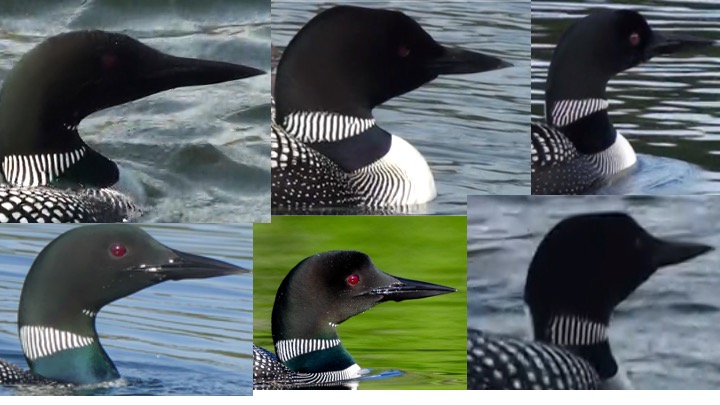
We face many difficulties in studying loons. They are aquatic. They dive and resurface far away when we approach them. They are gone for half the year. We can capture and mark adults only during a brief window when chicks are small. We cannot keep them in captivity, which limits what we can learn about their biology. Finally, loons are long-lived, so it requires decades to understand their life histories fully.
Back in 1993, when I informed her that I was about to begin a loon study, my postdoctoral advisor at Indiana University made a face. “Are you sure?”, she said. She was well aware of the difficulty of studying species like whales, eagles, tigers, and loons. These are beautiful, charismatic animals. But they are challenging to learn about scientifically. Was it wise for me, a young untenured academic, to embark upon a long-term investigation of a notoriously recalcitrant species?
No, it was not wise. But wisdom does not always guide our decisions. I felt drawn to loons. I also believed that the training I had received at Indiana, at Purdue, and especially from Haven Wiley, my PhD advisor at the University of North Carolina, had equipped me to ask rigorous, meaningful questions about the behavior of any animal.
When I first began my work in 1993, I recognized immediately that my greatest obstacle was going to be telling loons apart. This problem is familiar to behavioral ecologists. I had confronted it myself when studying wintering white-throated sparrows in North Carolina in the 1980s. But treadle traps allowed Haven and me to band hundreds of white-throats and recapture them at will. Moreover, we could see the bands on sparrows’ legs at all times.
Not so for loons. In most cases, we cannot identify an individual when it is resting on the water. Even when we have nailed the bands on both members of a breeding pair, we must reidentify each bird when it dives and resurfaces. (Every so often a loon has an oddity in its plumage or on its bill that sets it apart from other adults.)
Loons themselves must be far better at identifying others of their species than humans are. After all, if humans lose track of which loon is which during an observation session, we curse and make a few erasures on our datasheet. But a loon that mistakes an intruder for its mate might pay for the error with its life.
So it was with more than casual interest that Anna Alber and I entered the second phase of our analysis of loon appearance by computer. Could a computer learn to tell a large sample of loons apart visually? If so, then surely loons themselves can tell each other apart. A loon, of course, can base its identification not merely on appearance, but also on behavior and vocalizations.
Anna ran two trials. First, I identified 10 loons from Wisconsin and Minnesota for which we had at least 24 photos from a range of angles. Anna chose a set of “test” images of each loon in the sample and set them aside. She then “trained” the program to identify all 10 loons, using the remaining images. Upon testing, the computer correctly assigned 85% of Anna’s test images to the proper individual. Considering that pure chance would have resulted in a success rate of 10%, 85% seemed pretty good. In the next trial, we used 35 banded loons. This time I picked one test image for each loon, trying hard to select ones that closely resembled no other in the sample. In this go round, the program correctly identified loons at a 68% rate. Since random guesses would have resulted in a 2.8% success rate (1/35), Anna and I have begun to think that the computer knows what it is doing.
We found two additional patterns that shed light on the use of AI to identify loons from photos. First, in the cases wherein the computer correctly ID’d the loon in the test photo, it had 18.7 images to practice on beforehand, whereas the mean number of photos for misidentified loons was 11.5. In other words, when the computer had developed a good sense of what a bird looked like, it was better able to identify that loon later. Second, the computer was good at predicting its errors. In the 24 cases where it had ID’d a loon correctly, the computer’s average certainty of its guess was 81%. In contrast, the mean certainty of the computer for photos where it misfired was only 53%. And if we narrow the sample to instances when the computer had 90% certainty or more, it was right 12 of 12 times.
There is more work to be done in identifying loons from their photos. Phase Two, happening this year, will be to take photos of as many loons photographed last year as we can to see if the computer can use photos of a loon in one year to identify it in another year. This, of course, recreates the problem that male and female breeders across the Upper Midwest faced a few weeks ago when they returned to their territories and encountered an individual of the opposite sex. “Is that you?”
The photo above is by Hayden Walkush and shows the long-time male breeder on North Two Lake, near Lake Tomahawk, Wisconsin. Hatched and reared on Hodstradt Lake in 2007, this male settled on North Two in 2014 and has fledged four chicks on the territory since then. The Wisconsin Team found him back on North Two this past week, so he is back for another go!