It is one thing to lose your own young very early and then — at a weak moment — adopt young of another species that resemble your lost young. Adoption after hatching is an inherently risky move, and one likely to saddle you with the responsibility of rearing young very unlike yourself.

But how can things go sideways when you spend four long weeks on a nest and observe carefully as young emerge from the eggs you warmed with your own body? Surely any creature that fights its way out of an egg that you have incubated lovingly beneath you for so long must be worthy of your protection.

So it must have seemed to a breeding loon pair in northwestern Montana two days ago when three fluffy youngsters hatched and dutifully followed their parents onto the water. Yet the fluffy youngsters that popped out of the eggs the loon parents had spent countless hours incubating were not loon chicks, but Canada Goose goslings. So those cold nights, scorching afternoons, and relentless flying pests that the parents endured for four long weeks have produced a surprising outcome.

The loon parents do not seem disappointed. They have spent the past two days attending untiringly to their adorable, if unexpected, brood. And the goslings themselves betray no hint of alarm or discomfort — even when their parents vanish suddenly beneath the lake’s surface.

But Bob LeBlanc, the photographer who discovered this mismatched family, was left scratching his head. After hearing him recount the story of how a loon pair ended up with three goslings, I could shed no new light on the situation.

Certain facts seem clear. First, a goose pair nested on one of Bob’s three carefully constructed (for loons) nesting platforms but then inexplicably abandoned a clutch of eggs soon after incubation began. Finding an attractive nesting location, a later-arriving pair of loons apparently skipped the step where they deposit their own eggs there and instead simply decided to warm the eggs already on the platform.

I’ll be honest. As someone who has devoted his last three decades to learning about common loons and promoting their conservation, I have decidedly mixed feelings about loons raising goslings. The Canada Goose population in the Upper Midwest does not need loons to raise more of them. In fact, according to a recent study, there are about five times as many geese in North America now than in 1970. Goose numbers continue to rise in the Upper Midwest, where I do my research, leading me to worry that they are seizing good nest spots and keeping loons from using them. But for the moment, and in this one loon family, I have to admit that the fuzzy misfits are awfully cute.

Since we band hundreds of loon pairs, we get used to losing pair members here and there. The female on Sunday Lake, newly-banded in 2020, did not return in 2021. Likewise there is a new male on Clear2-Seven Islands, a new female on Towanda, a new male on Harrison Flowage. Some losses of old pair members are gut-shots. The absence of both pair members at Arrowhead reminds us of the tragic close to that lake’s 2020 breeding season. The Baker male’s disappearance is bittersweet; it brings back the recollection of his having reared a mallard duckling in 2019 with his mate. But after many years of watching breeders vanish, I now greet most such losses with only a sigh.

A bit more unsettling than mere disappearances of single birds — and far more interesting to a behavioral ecologist — are cases where breeder loss on one lake has ripple effects on lakes nearby. Since such domino effects seem to occur shortly after ice-out, when our lake coverage is spotty, we must usually guess at what transpired. In 1998 for example, the McGrath and North Two males, which defended adjacent lakes, seemed to switch places for no obvious reason. We inferred at the time that the huge North Two male flew over and evicted the smaller McGrath male, while the McGrath male assuaged his loss by settling on North Two, which his conqueror had just vacated. But we will never know for certain. A similar mystery occurred last year on Upper and Lower Kaubashine, whose males swapped lakes early in the year, before we were there to see how it happened. Again, we surmise that one male evicted the other, and the loser merely filled the victor’s breeding slot.

This year, we had enough observers present at critical moments to read the ripples more precisely. Following the eviction of his mate on May 3rd (Linda’s photo shows that evicted female), the Upper Kaubashine male — yes, the same male that had swapped territories in 2020 — must have decided that his breeding prospects were dim on Upper Kaubashine. So he looked nearby for an alternative. He found it on Silver, a small lake with an artificial nesting platform and a resident, Pat, who misses nothing. On May 9th, the Upper Kaubashine male intruded onto Silver, where the pair was incubating eggs, beat the resident male severely, and forced him to take refuge in a swampy area. The defeated male has not been seen since.

There is a ray of sunshine to share. The Upper Kaubashine male had no interest in sitting on the eggs of his predecessor at Silver, so the lake’s first nest was abandoned. But the usurper wasted little time renesting with the old female at the opposite end of the lake. Boosted in part by the earliness of ice-out this year, the Upper Kaubashine male might actually survive the loss of his mate and a vicious territorial battle of his own and still hatch chicks in June!

The events of the past few weeks on Upper Kaubashine and Silver reveal that chaos on one lake can spill over to others nearby. So if loons are capable of hope, they should hope for peace and tranquility for their neighbors as well as themselves.

As promised, we have begun to cover not only our original Wisconsin study area — in Oneida, Lincoln, and Vilas counties — but also territorial loon pairs in and around the Whitefish Chain, near Crosslake, Minnesota. This has not diminished our research in Wisconsin at all; we have exactly the same number of interns and field effort as in recent years. But we have increased the size of our field team and added Minnesota to the mix.

I have spent the past three days in the new Minnesota study area with three team members. Two of these folks — Katy and Jordana — will remain in Minnesota for the rest of the summer. They will scout out territories that we will begin to cover and also locate pairs with chicks, which we can capture and mark with leg bands. Following an intense banding campaign in July and August, we hope to have 40 or so territorial pairs in Minnesota marked and ready for study by late summer 2021 and perhaps 60-70 pairs by August 2022. We have learned quickly that Minnesota loons are even more tame and easy to observe than Wisconsin loons on average. So things look very promising for our research in the new study area.

After an early ice-out and a less severe black fly emergence than usual, both Wisconsin and Minnesota are seeing their first chicks. The featured photo for this post, taken by new team member, Kimi, shows some new arrivals and their tame parents from the Whitefish Chain. Many more pairs in northern portions of both states are within a week of hatching, like the incubating female below from Upper Whitefish, which was well hidden in

vegetation. So we are seeing the beginning of a wave of earlier-than-normal hatches in both Wisconsin and Minnesota. Breeding productivity looks to be far better this year than in either 2019 or 2020. In light of my concerns about the Wisconsin population, I am relieved to see reproductive numbers bounce back up this year. Let’s hope that this apparent breeding recovery continues.

By the way, we are now on Instagram! If you wish to see loon photos and video from Minnesota and Wisconsin in this much splashier format, follow us at @loonproject.

Few territories in the Wisconsin Study Area rival Flannery Lake in the futility of its breeding efforts. Despite at least one breeding attempt annually, Flannery has hatched only nine chicks since 1996. If that does not sound too bad, then consider that only two of those nine chicks reached ten weeks of age — the age at which young juveniles can be considered to have fledged. Moreover, one of those two fledglings was severely emaciated as a consequence of its father’s death, the father’s replacement by a new male, and the stepfather’s cruel treatment of it. We are quite doubtful that this unfortunate juvenile made it off the lake and migrated.

We cannot blame Flannery’s poor breeding record on the ineptitude of a few breeding adults. Over the quarter century of fruitless breeding attempts, four different males and four different females have ruled the lake, incubated eggs, and witnessed the loss of the nest or young. Each adult, in turn, has — it would seem — fallen victim to the lake’s curse. The breeding drought of the lake appears even more peculiar when one considers that Flannery was the most consistent and productive lake in the study area from 1991 to 1995. It is as if someone threw a switch in winter 1995, and the lake’s fortunes turned.

A cruel irony of Flannery’s reproductive struggles is that it possesses two clear hallmarks of a successful loon territory. The lake is both large enough — at 141 acres, counting its attached sister lake — and rich enough in nesting habitat — multiple islands — that we might have expected better. Indeed, every regular lake in the study area has outproduced Flannery in chicks, including dozens far smaller and with less suitable nesting areas. How has Flannery been able to do so little with so much?

Does Flannery merely typify the pattern of reproductive decline that I have mentioned so many times in recent blogs? That is, is Flannery simply a victim of the reproductive downturn that has hit all lakes in the area? No, the downturn of Flannery occurred much earlier and is far steeper than the downward slide of other study lakes. Flannery is truly unique.

I cannot solve the puzzle of Flannery’s demise as a chick-producer. I have consulted lake residents to learn why so many nests placed in safe locations have been inexplicably lost, so many healthy chicks have vanished without explanation. Some residents, like me, are getting a bit paranoid about the pattern. One said, years ago, that they thought “teens” might be to blame for disturbing nests and perhaps even taking eggs. But that possibility does not pass muster; surely teens that started hounding the loons or grabbing eggs in 1996 would have grown up and ceased this behavior by now.

Despite my unpleasant experience in tracking Flannery’s breeding history, I hold out hope for them each year. This year, I always think…..THIS year will be the one when they turn it around. In 2021 and from now on, perhaps, Flannery will come to resemble Muskellunge, a lake of similar size to Flannery and less breeding habitat — and one that has produced ten times as many chicks. Owing in part to the diligent egg-turning of the male and female there (see Linda’s photo), Muskellunge should hatch their eggs (again!) within a few days. Maybe Flannery will become the Muskellunge of the 2020s. Quite frankly, I do not see why not.

As I mentioned a few posts ago, the Loon Project is expanding into Minnesota, the state that contains more breeding loons than any other. Of course, our plan to establish a second study area 200 miles west of the current one in Wisconsin is ambitious. So I have enlisted the help of five LP veterans to help us cover our sprawling study area. These sturdy souls include Gabby and Linda, who are keeping track of our Wisconsin birds until the bulk of the team members arrive in a week, and Kristin, who, joined by new team member Katy, is taking our first look at the Minnesota study population. All of these folks have really stepped up for the Project.

Early-season work is both arduous and exciting. Arduous because we have so many loon pairs to visit. Arduous because these now hundreds of pairs must be visited one at a time and each pair member observed until we are confident we know its identity. But also exciting because we have not seen these birds since the previous summer, if at all. During the fall, winter, and spring periods, many of our loons have died or been evicted by younger rivals. And many of these young upstarts are birds we banded as chicks five to ten years ago on adjacent lakes.

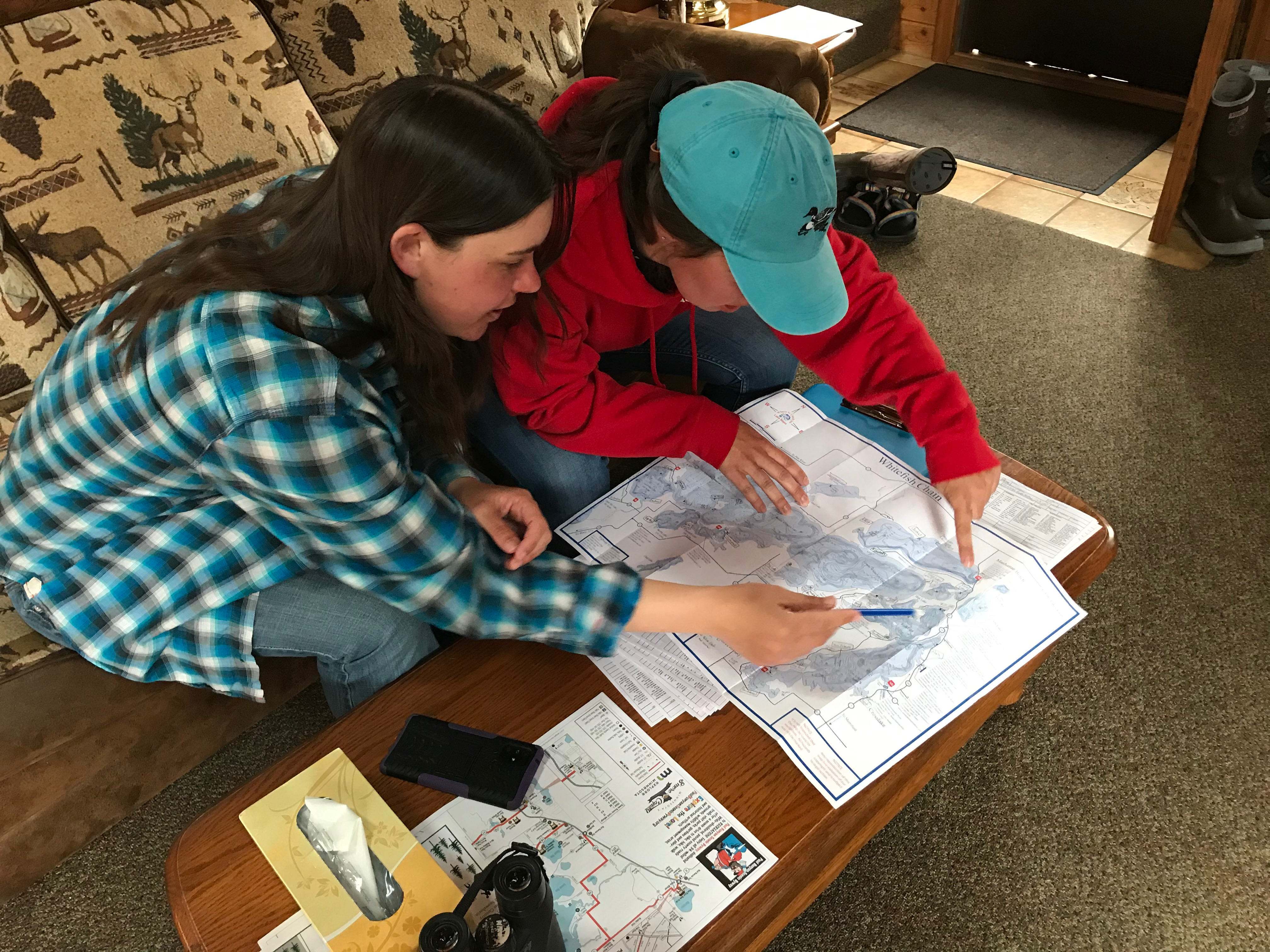
Minnesota is a whole different ballgame. When we decided to take on the task of starting a new study population on the lakes in and around Crosslake, we knew that we were making a pledge to cover brand new lakes whose loons were abundant but little known. We also understood that, unlike our breeding pairs in Wisconsin, most of the Minnesota loons defended territories on the massive Whitefish Chain, where our protocol of dropping solo canoes in at boat landings and paddling to the birds was unworkable. In short, we were pledging to take on a new study population that required a completely different mode of research.

I couldn’t wait to get started. Though tethered to my instructional responsibilities in California, I gazed at these unknown Minnesota lakes on Google Earth and felt my excitement build. I collected what information I could about the lakes and loons from folks in the area. I studied maps of loon activity and banding logs provided by Kevin Kenow of USGS, who captured and marked a few dozen birds on the Chain five to six years ago and generously shared his knowledge and data. And I scratched my head.

Since I was out of commission, I needed to find someone with great knowledge of loons and a willingness to confront the daunting challenge of making our first visit to the Chain. I told Kristin that I needed her to: 1) visit an unknown study area, 2) census dozens of unknown pairs, most of which would be unmarked, 3) travel by large motorboat on an unfamiliar lake with tricky wave and wind conditions, 4) work out all of the logistics of this work with a group of unfamiliar (but enthusiastic) Minnesotans, and 5) get permission from her advisor to suspend her Ph.D. preparation and take on the project at all. I am not sure how I managed to ask her with a straight face. Predictably, though, Kristin’s response was: “Oh – that would be a blast!”. And so Kristin has begun this crucial reconnaissance. Joined

Kristin and Katy study a map of the Chain before setting out to find loons.
One of the ten nests found by Kristin and Katy on the Whitefish Chain.

by Katy, a new LP team member who is fluent in the local dialect and has turned out to be a quick study, Kristin has now covered all but a few nooks and crannies of the Chain. As of this writing, K and K have found 45 breeding pairs on the Chain and ten active nests, like the one shown above. Most of the pairs are unmarked, but they report 14 of Kevin’s banded adults are still on territory. (These marked individuals will be most valuable, as they will permit us to make preliminary estimates of territory eviction and survival for the new study population.) K and K will wrap up their coverage of the big water today, they say, and spend the next few days visiting small lakes adjacent to Whitefish. These small

Katy attempting to ID a loon.

lake visits will no doubt bring a tear to Kristin’s eye, as they will recall the work she used to do back in the Wisconsin study area.

By starting before sunrise, Kristin and Katy made the most of windless conditions.

Kristin and Katy’s effort to establish a foundation for our Minnesota work epitomizes the work of the Loon Project. We pride ourselves in carrying out research that is uncomfortable and physically-demanding, yet also exacting and painstaking. We tackle research questions that most others deem inaccessible. The work just seems too difficult, our study animals too recalcitrant. How can one accumulate sufficient data to test hypotheses about animal behavior and ecology under these conditions?

One of the 14 banded loons found on the Chain.

I was on pins and needles. Gabby had moved steadily northward and westward in her censusing of our study lakes. She started in Rhinelander. This from her datasheet Thursday:

Mildred:

  1. O/Ts, W/S (O & left leg double confirmed)
  2. Unb, Unb (both legs double confirmed)

Maud:

  1. P/S, G/G (P & left leg double confirmed)
  2. Unb, Unb (both legs double confirmed)

Coon:

  1. Ronly, Bs/S (both legs double confirmed)
  2. Unb, Unb (almost positive it’s unbanded – never saw its legs out of water, but had many chances to see bands in good light underwater if there were any present)
  3. Intruder = Y/Y, Bs/S (both legs double confirmed). Interacted with pair for 10 minutes.

Ole:
No loons

Soo:

  1. M/S, W/B (both legs double confirmed)
  2. Bs/M, Mb/S (right leg and Mb double confirmed)

At the rate she was covering lakes, I gauged that Gabby would get to Upper Kaubashine on the 3rd, 4th, or 5th. I almost asked her to jump ahead to Upper Kaubashine, but I did not want to kill her momentum. But it was hard to wait and see whether the oldest known loon in Wisconsin, thirty-three-year-old “Red-Green”, had returned to her breeding territory.

When Gabby’s report came, it was not what I had expected:

Upper Kaubashine
Sooo the good news is I found the male (Cc&S, G/G – all confirmed) and that old female (S/Y, R/G – all confirmed). The bad news is the old female may have met the end of her tenure and potentially her demise at the hands (wings??) of an Unb, Unb (confirmed) intruder who was on the lake interacting with the pair when I arrived. I witnessed a VICIOUS 12 minute battle between the female and the UNB where they were latched onto each other’s throats and beating each other with their wings (both were covered in blood) for about 8 minutes, until the old female started fleeing underwater. But the UNB was relentless and pursued her, beating her the whole way. Then the old female finally made it to little islet and looked like she was trying to find a place to go on shore, but ended up being trapped against the islet while the UNB continued to stab her with her beak and beat her. The old female finally gave out a two note wail and then the UNB finally stopped and left to go preen elsewhere. I thought the old female could be dead already, but when I left her at the shoreline she was still turning her head. I hope she can hide long enough to recover to get off the lake, but the way she was being attacked, it did not look good.

Although we have studied them for decades and know their behavior well, we find it freshly shocking to watch loons battle. The brawl that Gabby describes was more violent than any of the few dozen or so that I have seen over the years. Despite the whipping of wings and jabbing of bills that these fights entail, one almost never sees blood. However, what began as a stereotypical head-grasping and wing-beating contest, she reports, quickly morphed into an all-out struggle for survival — once resident Red-Green recognized that she was overmatched and her goal changed to self-preservation.

Physical features of a lake can play a role in territorial battles. In fact, a lake’s shape, size, clarity, and peninsulas and islands often determine whether a fleeing bird eludes its victorious opponent and flies off to a nearby lake to lick its wounds or fails to do so, suffers repeated pummeling, and ultimately dies on the lake it used to own. After the Upper Kaubashine battle, the clarity of the lake water made it simpler for Red-Green’s pursuer to track her underwater, complicating her efforts to reach safety. Thoroughly defeated but unable to elude her opponent, Red-Green was ultimately pinned against the long peninsula near the southern end of the lake, as Gabby describes.

We have no idea how Red-Green managed to escape the unbanded female’s grasp. What we do know, thanks to Linda’s visit to Upper Kaubashine today, is that, despite her dire circumstances two days ago, Red-Green is still alive. Linda was relieved to find her hugging the shoreline — as her photo shows — and skulking about under piers at the north end, while the male and his new mate cavorted far to the southwest in the protected nesting bay. Though clearly beaten up, Red-Green seems safe for the time being. Indeed, maybe she will emulate thirty-one year-old White-Yellow, a long-time breeder on West Horsehead. Evicted in 2019 after breeding on one lake for a quarter century, White-Yellow resurfaced this spring as the new breeding female on productive Little Bearskin Lake. In their tireless efforts to cope with defeat, bounce back, and resume productive lives, Red-Green and White-Yellow exemplify the dogged tenacity of female loons.

Although I am stuck in California teaching for another few weeks, others have been hitting the lakes. Based on thirty or so lakes from which I have had reports — mostly Linda’s work, but also a few lake residents — we have an early read on the return rate of adult loons from last year.

Let me explain. April and May are exciting months for the Loon Project, because we hustle from lake to lake to see which of our banded adults have returned and which have not. In a typical year, the vast majority of our study animals have managed to survive the winter, navigate fall and spring migrations successfully, and take possession of the territories they occupied the previous year. The figure hovers around 80 to 90%. A high rate of annual survival is vital to our population. The low reproductive rate of loons is sufficient to sustain the population only because most adults survive each year.

During years when I am able to steal away from my pedagogical commitments, I find these “censusing” visits oddly thrilling. On my first lake visit of the year, I fancy that the male and female both pause for a moment, wheel in my direction, and think, “Where’s he been?” This might not be pure imagination; after all, I have been observing most of these individuals for a decade or more.

Last year seemed an exception to the typical high rate of adult return. Fully a quarter of the adults that we left behind safe and sound in the early fall of 2019 failed to come back in the spring of 2020. While some of these adults had merely been evicted from their territories, most were dead. Coupled with our recent finding of population decline in northern Wisconsin, the low 2020 return rate weighed on my mind last spring. On the other hand, return rates bounce around. So I tried to avoid jumping to the conclusion that adult survival was going downhill.

Recent reports from the lakes this year have placed concerns about adult survival front and center again. Each of Linda’s almost-daily census visits seems to bring fresh news about a missing adult or breeding pair. Early on, Linda reported that a new male had replaced the long-time resident male on Manson. Okay, that happens, I thought. Nothing to worry about. The Deer Lake female, freshly marked in 2020, also turned up missing. A Halfmoon Lake visit brought no better news; the 2020 female from there was gone as well. Hildebrandt and Julia, always occupied by pairs and frequent chick producers, were vacant. Linda’s trip to Nokomis Lake was most devastating of all. Towards the eastern end of the lake, both members of a long-term pair with a consistent record for rearing chicks were AWOL. And Linda turned up only one unmarked loon from the entire 2200-acre Nokomis flowage, which usually supports three breeding pairs.

He did not know it, but Al from West Horsehead produced the straw that broke the camel’s back. His report from this morning that the 8-year-old West Horsehead male had been replaced by a 6-year-old male from neighboring East Horsehead hit me especially hard. The sample had become large enough that I could not longer deny the pattern. Looking at the number of returns right now, we have found only 21 of 31 adult loons that should be on territory. Now, we will track down some of these missing birds. A few will be alive and breeding on a seldom-visited lake near their old territory. And that will give us a momentary lift. But an adult return percentage in the low-70s, as we are seeing for the second straight year, will not sustain our breeding population for long.

By training I am a behavioral ecologist. That means that my background and experience help me understand what behavioral answers have evolved in response to the ecological problems animals face, like avoiding predators and finding a mate. So I am especially interested to learn why loons that are rearing chicks abandon them for periods of an hour or more to visit the neighbors, and why female territory holders are able to surrender their territory to a superior opponent and live for another day while male territory holders in the same predicament seem unable to sense the danger and often die in territorial battles. But such questions pale when compared to a single, burning question we have faced for the past year on the Loon Project: “What is causing the northern Wisconsin loon population to decline?”. That question has become a nagging source of unease that prevents me from feeling fully comfortable anywhere and at any time.

There are many possible reasons for the decline: the exploding eagle population, decreased fish numbers, human impacts like increased boating or angling. And, of course, climate change, which impacts temperature, rainfall, and extreme weather events, is the elephant in the room. Learning about and systematically eliminating each potential cause of the decline will require me to find and collaborate with other scientists who know about fish, eagles, human impacts, and climate. In other words, cracking this nut will force me far outside my comfort zone.

We have glimmers. My collaboration with Sarah Saunders showed us that increased rainfall, increased human settlement, and the North Atlantic Oscillation – a broad-scale climatic event that influences weather in the northern Hemisphere – are all linked to both lower breeding success and lower adult survival of our loons.

A month or so ago, Linda and her husband, Kevin, speculated that increased boat traffic on large lakes might be the cause of the reproductive decline of loons in Wisconsin. They reasoned that more big boats might churn up the water, reduce water clarity, and make it harder for loons to find their prey under water. Such a scenario might make chicks grow more slowly now than 25 years ago and cause higher chick mortality.

Water clarity has always been a prime suspect among factors likely to influence loon survival and breeding success. As visual predators, loons must be affected by water clarity. Right? Yet we have no evidence to date that clarity affects loons. Brian Hoover’s recent paper, for example, showed that juvenile loons try to forage on lakes similar to their natal one in pH, but not in clarity. Our analysis from several years ago showed that young loons tend to settle on breeding lakes similar to their natal one in overall size and pH – but, again, water clarity is not a factor. Moreover, a glance at our study lakes shows that loons survive well and produce chicks on lakes that range from crystal clear (20 feet of visibility or more) to very murky (4 feet or less of visibility). If loons live and breed successfully on lakes that vary so greatly in clarity, perhaps clarity simply does not matter at all.

Nudged by Linda and Kevin to look once more at water clarity, I finally had some success. When two new collaborators at Rensselaer Polytechnic Institute provided me with thirty years of water clarity data based on satellite overpasses from my Wisconsin study lakes – and I plugged those data into my statistical models – suddenly clarity mattered. To be specific, mean water clarity during July was a significant predictor of chick mass. Clear water produced fatter loon chicks! Furthermore, chick survival decreased significantly in cloudy lake conditions.

Wait……what does this pattern mean? If you are like me, you think of water clarity as being constant or static for a lake. That is, you consider Two Sisters Lake as a very clear lake and Pickerel Lake as a murky lake. And you are correct. But those lakes – all lakes – fluctuate in clarity seasonally, annually, and even over days or weeks. Runoff events caused by rainstorms reduce clarity, for example, because silt and other materials are carried by streams into lakes. So you can have a bad few weeks or month for clarity on a lake that is generally quite clear. And a very clear lake can gradually become less clear over the years. The new satellite data are showing us that such short-term fluctuations in water clarity are associated with lower chick mass. It is a conceptual leap, but the obvious interpretation here is that short-term losses in water clarity impair foraging by loons and reduce the amount of food they are able to provide for their chicks.

It is early days. My collaborators are refining their estimates of water clarity from the satellites for northern Wisconsin and promise improvements by October. Meanwhile, I am left to ponder two things. First, water clarity in northern Wisconsin has declined over the past ten years, as the featured graph shows. Second, if recent declines in lake clarity really do hurt loons’ ability to catch prey for their chicks, what can a single loon researcher do about it?

We are not the only people who study loons. In fact, dozens of researchers from Iceland to Montana…from Alaska to Massachusetts…and from British Columbia to Newfoundland have done so. And that is to say nothing of loon study that occurs on the wintering grounds.

Loons are, of course, engaging animals. It puts a spring in my step just to tell people that I study them. And the same is true of dozens of undergrads, Masters’ students, and loon enthusiasts who have chosen to spend time with these odd and fascinating birds.

But spending time with loons and gaining useful knowledge about them are two different things. Much of the basic information about the life-history of the species — where they nest; when they arrive on lakes in the spring; what their predators are — has been understood for some decades. So folks who observe the behavior of loons during the breeding season, even with a keen eye, have a hard time contributing to our knowledge of the species.

There is an exception. Marking of animals for individual identification throws open the door to an abundance of exciting and useful research questions. Once we had marked a few dozen loons in the 1990s and begun to follow their lives closely, we quickly put to rest the abiding — though scientifically implausible — legend about the species: that they mate for life. We now know that a typical adult has several different mates during its lifetime. More profoundly, we now know that loons are decidedly unromantic. A loon’s bond is to its territory, not its mate. When loons fight, they fight to retain their ownership of a territory — and to remain paired with whatever individual of the opposite sex has succeeded in maintaining its own bond with the same territory. Having loons banded has forced us to recognize the shocking fact that established breeders whose mate is evicted by a competitor simply pair quickly with the competitor, leaving their previous mate on its own to cope with the loss (on a new territory).

Marking of loons also exposed a peculiar finding about the species: that males choose the nest site. Since we have breeding pairs marked, we have measured statistically how males take the lead when pairs are nest-searching. More to the point, we have shown that the disappearance of a male breeder causes a territorial pair to “forget” nesting locations that they used successfully in the past.

While color-banding of loons is immensely valuable for behavioral study, it is even more so for monitoring populations. This is easy to understand. Once you start marking animals and systematically working to resight them, you learn at what rate they return annually to breeding territories. Instances of return or failure to return allow us to construct a population model to estimate adult survival. And if resighting efforts take place within a tight cluster of study lakes that are visited regularly, a researcher can refine the population model by accounting for those frequent cases wherein an adult loon failed to return to its lake not because of mortality but because a competitor evicted it and forced it to move to a new breeding lake nearby.

In fact, it is our intensive — almost obsessive — efforts to relocate adults lost from their original territories that makes our study methods unique. The obsession extends to loon chicks as well. That is, we search far and wide to find the breeding territories of loons that we banded when they were four to six weeks old. To date, we have discovered 183 chicks that matured and settled on territories 4 to 11 years later. These data further improve the population model, because they permit us to estimate survival of chicks to adulthood. Linda found our latest case of settlement by an adult-banded-as-chick on Manson Lake just yesterday. She tells me that this is the first instance in which she took a photo of a chick (above photo of the 2013 family on Jersey City Flowage) and then snapped another of that same loon after it had returned as a territorial adult (see photo below of this eight year-old yodeling yesterday on Manson Lake).

We are still going strong in Wisconsin. Each year that passes improves our known-age data on adults and chicks banded as long ago as 1993. This year, though, through a brand new partnership with the National Loon Center in Crosslake, we are bringing our technique of intensive mark and resighting to Minnesota. In the next several years, we hope to share better tidings with lovers of loons in central Minnesota than we shared recently with loon enthusiasts in Wisconsin.