We are not the only people who study loons. In fact, dozens of researchers from Iceland to Montana…from Alaska to Massachusetts…and from British Columbia to Newfoundland have done so. And that is to say nothing of loon study that occurs on the wintering grounds.

Loons are, of course, engaging animals. It puts a spring in my step just to tell people that I study them. And the same is true of dozens of undergrads, Masters’ students, and loon enthusiasts who have chosen to spend time with these odd and fascinating birds.

But spending time with loons and gaining useful knowledge about them are two different things. Much of the basic information about the life-history of the species — where they nest; when they arrive on lakes in the spring; what their predators are — has been understood for some decades. So folks who observe the behavior of loons during the breeding season, even with a keen eye, have a hard time contributing to our knowledge of the species.

There is an exception. Marking of animals for individual identification throws open the door to an abundance of exciting and useful research questions. Once we had marked a few dozen loons in the 1990s and begun to follow their lives closely, we quickly put to rest the abiding — though scientifically implausible — legend about the species: that they mate for life. We now know that a typical adult has several different mates during its lifetime. More profoundly, we now know that loons are decidedly unromantic. A loon’s bond is to its territory, not its mate. When loons fight, they fight to retain their ownership of a territory — and to remain paired with whatever individual of the opposite sex has succeeded in maintaining its own bond with the same territory. Having loons banded has forced us to recognize the shocking fact that established breeders whose mate is evicted by a competitor simply pair quickly with the competitor, leaving their previous mate on its own to cope with the loss (on a new territory).

Marking of loons also exposed a peculiar finding about the species: that males choose the nest site. Since we have breeding pairs marked, we have measured statistically how males take the lead when pairs are nest-searching. More to the point, we have shown that the disappearance of a male breeder causes a territorial pair to “forget” nesting locations that they used successfully in the past.

While color-banding of loons is immensely valuable for behavioral study, it is even more so for monitoring populations. This is easy to understand. Once you start marking animals and systematically working to resight them, you learn at what rate they return annually to breeding territories. Instances of return or failure to return allow us to construct a population model to estimate adult survival. And if resighting efforts take place within a tight cluster of study lakes that are visited regularly, a researcher can refine the population model by accounting for those frequent cases wherein an adult loon failed to return to its lake not because of mortality but because a competitor evicted it and forced it to move to a new breeding lake nearby.

In fact, it is our intensive — almost obsessive — efforts to relocate adults lost from their original territories that makes our study methods unique. The obsession extends to loon chicks as well. That is, we search far and wide to find the breeding territories of loons that we banded when they were four to six weeks old. To date, we have discovered 183 chicks that matured and settled on territories 4 to 11 years later. These data further improve the population model, because they permit us to estimate survival of chicks to adulthood. Linda found our latest case of settlement by an adult-banded-as-chick on Manson Lake just yesterday. She tells me that this is the first instance in which she took a photo of a chick (above photo of the 2013 family on Jersey City Flowage) and then snapped another of that same loon after it had returned as a territorial adult (see photo below of this eight year-old yodeling yesterday on Manson Lake).

We are still going strong in Wisconsin. Each year that passes improves our known-age data on adults and chicks banded as long ago as 1993. This year, though, through a brand new partnership with the National Loon Center in Crosslake, we are bringing our technique of intensive mark and resighting to Minnesota. In the next several years, we hope to share better tidings with lovers of loons in central Minnesota than we shared recently with loon enthusiasts in Wisconsin.

Inevitably the news comes in the form of an excited text message from Linda. This year it came on March 30: “Yippee! Clune is back”. “Clune”, a tame 23-year-old territorial male on Muskellunge Lake, got his name as a result of an autocorrect/typing error of mine a decade or so ago. He has been one of our most successful male breeders, having fledged 17 chicks on two different territories with at least four different females since 2003. Last year he gave us a scare when he showed up a week after ice-out and had to drive the neighboring male from Deer Lake off of Muskellunge in order to reclaim it for himself. This year Clune left no doubt: he arrived as soon as the water opened up on Muskellunge. He is alone at the moment. This is not unusual; males commonly arrive on the breeding grounds a few days ahead of females. Linda says that he spent some of his alone time giving soft-wails, as if calling for his missing mate. “Honey”, as Linda calls Clune’s equally-accomplished breeding partner, should be along shortly.

Clune is not the only loon back in the study area. I have reports of loons back on two more lakes that are completely or partially open. In short, it is early April and already the loons are returning to their breeding territories. Since I am in the midst of an extremely busy spring semester of instruction, and am two-thirds of a continent away, I can only sigh and try to remain patient. I am trying to stay positive. After all, I am only six weeks — nine quizzes, two midterms, a scientific report, two final exams, and fifty-four office hours — away from joining the loons!

Fortunately, others are stepping up in my absence. We have a large and seasoned team that will help me learn which of our banded loons have returned. Gabby will be sneaking away from her graduate work at Illinois to cover the Wisconsin study area in early May, and Kristin will dodge her major professors in Madison for a week and zip over to Crosslake, Minnesota to begin covering our brand new population on the Whitefish Chain. Three other veterans are returning from last year: Brian, a postdoc at Chapman, and Martha and Allison (my daughter). Brian will be on site in Wisconsin for most of the summer. Martha and Allison will scout lakes and help with capture in Crosslake in July.

Crosslake??? Minnesota??? That’s right! One of my responsibilities as the new National Loon Center Scientist will be to roughly double the number of breeding loon pairs under intensive study in the Upper Midwest by starting an investigation in the state that supports as many breeding loons as the remaining 47 contiguous United States combined. Our new Minnesota population, centered at what will be the National Loon Center headquarters in Crosslake, should equal the Wisconsin population in number of marked pairs under study by 2025.

Why a second study population? Our worrisome population data from Wisconsin has made it clear that we need better data across the southern fringe of the common loon’s breeding range. This will allow us to determine, for example, if the dip in the northern Wisconsin population is a local phenomenon or part of a broader pattern of decline. Strangely there are no long-term demographic data in Minnesota that permit us to construct a population model. So we simply do not know how healthy the Minnesota population is. As a worrywart, I am concerned that Minnesota’s loons might be in trouble, like those in Wisconsin. After all, Minnesota is right next door and the loons there face a similar set of environmental challenges. We shall see!

In the meantime, keep me in mind. And let me know if you see any interesting loon behaviors or any loons in trouble. I shall be mired in paperwork for the time being and connected to the loons only by Linda’s striking photos – like the one above of Clune from a few days ago — and reports I receive from folks on the lakes.

We are gearing up for another year of field work. This one is going to be a doozy, because we will be adding a new study population. That’s right, we are expanding west into Minnesota and beginning a partnership with the National Loon Center in Crosslake, Minnesota. Once we complete our capture and marking of the loons in northern Wisconsin, we will head west to mark dozens more in and around Crosslake. I will say more on this topic in the coming weeks.

Meanwhile, we face a familiar obstacle: limited housing. We have our usual Wisconsin team of 5 to 6 members this summer, and nowhere to put them between July 1st and August 10th. How did this happen? First, our funding came in later than usual. Second, we were about to close on a deal for a cottage to cover the entire period, and the owners suddenly changed their minds. So please let us know if you know of a place somewhere in the Rhinelander – Minocqua area where we might stay. We can afford to pay a reasonable rent as well.

Meanwhile, meet Katy, one of our new field interns this year. It is fitting to include Katy in this post, because she, like our new study population, is from Minnesota! In fact, she will be traveling with veteran Kristin to Crosslake in early May to help locate loon pairs that will be part of the new Minnesota study population!

We have had an exciting last few weeks. First, our paper on population decline in northern Wisconsin has been the most frequently read paper in Condor: Ornithological Applications every single day during the past three weeks. Of course, I jinxed it, and when I looked just now I found that we have fallen and are only the second-most read paper! In any event, we seem to be getting the word out about problems that loons are facing in the Upper Midwest.

Second, Brian Hoover’s paper that describes and explains lake preferences of juvenile loons — those that have just fledged and become independent of their parents — has just come out. Brian’s paper shows that juveniles tend to visit lakes that have similar pH to their natal lakes and also that they use large lakes with a variety of fish species present. In other words, if we are to preserve the Upper Midwest loon population, we must look out not only for lakes where loons nest but also those lakes nearby where juveniles fatten themselves up to prepare for migration.

Third, our collaboration with Sarah Saunders of Audubon has borne fruit; Sarah’s paper has just been accepted by Journal of Animal Ecology and should appear as an accepted article in the next week or two. Her model, which combined measures of land use, climate, and our study population, indicates that the North Atlantic Oscillation — a fluctuating climatic pattern that is projected to increase under climate change — is having a net negative impact on both adult loon survival and chick production in northern Wisconsin. The pattern is complex, but it dovetails logically with the population trends we have seen in northern Wisconsin. The simplest interpretation of her findings is that the North Atlantic Oscillation affects food levels on the loons’ wintering grounds, which, in turn, impact survival and subsequent chick production. Sarah also found that increased human development reduced adult loon survival. Most alarmingly, Sarah’s simulations of the next decade all project decline for the northern Wisconsin population, just as our Condor paper did. So, we must look for more ways to boost loon breeding success and adult survival on the breeding grounds in an effort to counter what is a most worrisome trend.

Sarah’s findings place new urgency on my efforts to understand all 12 months that constitute a year in a loon’s life. Most recently, I have batch-plotted recoveries of loons banded in northern Wisconsin that covered distances of more than about 200 miles. As you can see from the featured image above, we have a lot of these data. (You might have to click on the title in the e-mail to see the map.) Leaving aside the small number of interesting shifts westward and northward, the photo confirms the wintering pattern that I mentioned in a recent post. Our Upper Midwest loons winter in large numbers along both coasts of Florida — especially the Gulf Coast. About a quarter of our loons, however, winter off of the Carolinas, especially North Carolina. Concerned as I am with the increased rate of mortality among adults in recent years, I cannot help thinking that hazards along these coastlines are creating trouble for them. Clearly while I can use the fall, winter, and early spring to rest and recover after intense field work during May, June, July and August, my study animals do not have that luxury.

No, I am not talking about the Buccaneers. Kansas City and Tampa are both far from anywhere I have spent meaningful time. Besides, KC won last year, and Tom Brady has won countless times. Enough already!

I am talking about Tampa Bay the place — the large, protected inlet halfway down the west coast of the Florida peninsula. Loon enthusiasts should love Tampa Bay because it serves as the wintering grounds for a good many loons from the Upper Midwest. In fact, so far 33 of 53 recoveries of loons banded by the Loon Project and others in the Upper Midwest — sadly, these are mostly loons found dead on the beach or elsewhere and reported to the Bird Banding Lab in Maryland — have come from Florida’s Gulf Coast, between Pensacola and the Keys. By chance, or more likely just because it is an area of dense population, a good percentage of these birds come from the Tampa Bay area.

This is not a brand new finding. Kevin Kenow of USGS has used satellite transmitters to track loons from Minnesota, Wisconsin, and Michigan and reached the conclusion that Florida’s Gulf Coast is a vital wintering area for our birds. He puts the percentage of Upper Midwest loons that winter there at above 70%. So we have two separate lines of evidence that tell the same story about the wintering location of Upper Midwest loons. Well, okay, you must be thinking, our loons have to winter somewhere. Why does it matter where exactly? It matters because, while we only see them in the summer and tend to focus only on their trials and tribulations during summer, our loons must also survive on their southward migration, sustain themselves on the wintering grounds, and then make it through another northward migratory journey in order to get back to us each year. Of the period during which it is out of our sight, a typical loon from our area spends four to five months on Florida’s Gulf Coast.

When you learn where breeding animals are spending their winters, conditions on the wintering ground suddenly get very real. During the past two decades, ecologists have improved in the ability to track individual animals (usually birds) from breeding to wintering locations, using such tools as satellite transmitters and geolocators. They have also learned that migratory trips do not somehow “reset” an individual so that all individuals that have migrated to the breeding ground start on equal footing. Instead, a difficult (or easy) migration or wintering period leaves a lasting imprint on an animal, placing it at a disadvantage (or giving it an advantage) during the next phase of its life history. Such impacts are called “carryover effects” and have become hot topics for investigation. Surges or declines in breeding populations, we now see, can be as easily explained by events on the wintering grounds as those during the breeding season.

We are at an early stage in our analysis of breeding season impacts on wintering loons and vice-versa. In fact, we know nothing about carryover effects in loons. But now that we are zeroing in on wintering locations of loons from different breeding populations, the stage is set to look for such patterns. At the moment, I have set my sights on a less lofty goal. You might recall my post in June 2020, when I pointed out how many adult loons had failed to return to Wisconsin in spring of 2020 after leaving in fall 2019. The simplest explanation for this very low return rate of Wisconsin breeding adults is that some event occurred during the winter of 2019-2020 along the Florida Gulf Coast that killed many loons there. More broadly, I have begun to explore data that Florida wildlife officials collect annually on red tides and other environmental events that threaten ocean-dwelling animals. Could fluctuations in annual survival rates of loons in Wisconsin be explained by mortality events recorded along the Florida Gulf Coast?

Science is, by nature, cumulative. Theories put forward centuries, decades, or years ago form the foundation of ideas we test today. If those theories fail to explain patterns we see in nature, they are refined or discarded and replaced by new theories that themselves must be tested ceaselessly and revised or rejected.

For our part, we scientists spend years learning our field, which means achieving a deep understanding of the sweeping theories that have withstood the test of time. We also must have an intimate knowledge of recent findings of colleagues in the sub-discipline that forms the context of our own research.

The way that scientists carry out the scientific process should sound robust and logical. It is. This approach has led to steady progress in our understanding of the world and a guarantee that — although we may occasionally take a wrong turn in understanding some process or phenomenon — we shall not stray too far and for too long.

But the innate teamwork that typifies the scientific process has a major drawback. So desperate are scientists to keep up with discoveries and hypotheses of others in our own discipline that we expect to replicate their findings in our own work. Of course, such replication is vital to the scientific process; repeated similar findings confirm for scientists that we are seeing consistent patterns and have a solid understanding of nature. In our tendency to look for and find what others have found, though, we are often blind to what is novel. Indeed, if we discover some oddity, we are more likely than not to try to reconcile it with current theory by treating it as an aberration or an artifact of our procedures, rather than a truly new pattern that we do not yet understand.

So it was with spotlighting by loons. For years, I had observed the visits of territorial loons to their neighbors’ lakes. This behavior was curious, to be sure, but my training convinced me that these visits must have an explanation within the fabric already woven by other scientists. No, we would not expect territorial pairs with chicks ever to leave them at home and visit their neighbors with chicks. It made no sense. But until I took a long, hard, robust look at our data, I simply shrugged and trusted that someday we would be able to make sense of it based on what my scientific colleagues had found in other species.

On the other hand, all scientists are aware of this bit of wisdom familiar to fans of Sherlock Holmes:

When you have eliminated the impossible, whatever remains, however improbable, must be the truth. —Arthur Conan Doyle

Most ecologists encounter this situation seldom. It is, as you must imagine, a most unsettling outcome. However, in trying to test hypotheses to explain intrusions by loons with chicks into neighboring lakes, I encountered this situation exactly. Territorial loons, I thought, might be visiting their neighbor’s territories to look for food. That possibility did not stand up to scrutiny; intruders rarely forage during intrusions. Neighboring pair members, I reasoned, might intrude to learn about nearby territories, so that they would be positioned to “trade up” to a new one, given the opportunity. This possibility works for neighbors that failed to produce chicks, which sometimes trade up to the territory next door, but not for neighbors that hatched chicks themselves, which do not. Neighbors with chicks might intrude because — if they wish to draw attention away from their own chicks — they must go somewhere. This explanation fails because parents would be better off, in that case, visiting one of the many uninhabited lakes throughout the study area, where they could forage without interference from other loons and replenish their energy reserves. The fact that parents target other territories with chicks in precise, laser-like fashion rather than studiously avoiding them indicates that they are visiting specific territories with a specific goal. Thus, the improbable explanation that remains after all impossibilities fall away is spotlighting.

To conclude that loons are reciprocally spotlighting each other’s chicks is unsettling. No one has ever proposed such a convoluted mechanism of territory defense before. Our ability to develop the spotlighting hypothesis depended upon knowing loon behavior intimately. When you consider that: 1) nonbreeding floaters are obsessed with finding chicks to gauge territory quality for eviction attempts, 2) pairs with chicks are desperate to hide them from floaters, and 3) floaters are strongly attracted to other adults already intruding in a territory, it is not a great conceptual leap to suppose that adults eager to hide their own chicks would visit the neighbors to draw floaters to the neighbors’ territory and the neighbors’ chicks.

Since I am on a roll, I will add that the form of eavesdropping that loon pairs appear to do on each other’s yodels to keep track of each other’s breeding success is rather novel. That is, behavioral ecologists have long known the animals listen to each other and intercept each other’s messages in order to boost their own reproductive opportunities. Nightingales, for example, use their neighbors’ songs to determine where intruders are, so that they can defend their territories more effectively. But the kind of eavesdropping that I propose in loons — whereby loons use intercepted yodels to learn about neighbors’ chicks, spotlight neighbors’ chicks, and thus cause nonbreeders to evict neighbors — is far more sinister. The fact that eavesdroppers are causing harm to the loons whose yodels they intercept sets the loon system apart from other forms of eavesdropping that have been described in animals.

2009 video from Spider Lk, Oneida County.

I know. Web sites, books, “loon experts” — and our own hearts — tell us that loons are fundamentally good. Even when a pair with chicks hides them along a shoreline while confronting a raft of intruders, all of the attendees of the social gathering seem so respectful to each other, so congenial. But I am going to ask you to take the same sort of journey that I did as a scientist recently. Despite having been steeped for decades in narrow, Pollyannaish loon lore that holds that all loons are friends and are looking out for each other and the population as a whole, open your mind to the possibility that loons, like humans, do not always see eye to eye. Maybe, like me, you will find that this brings you closer to them.

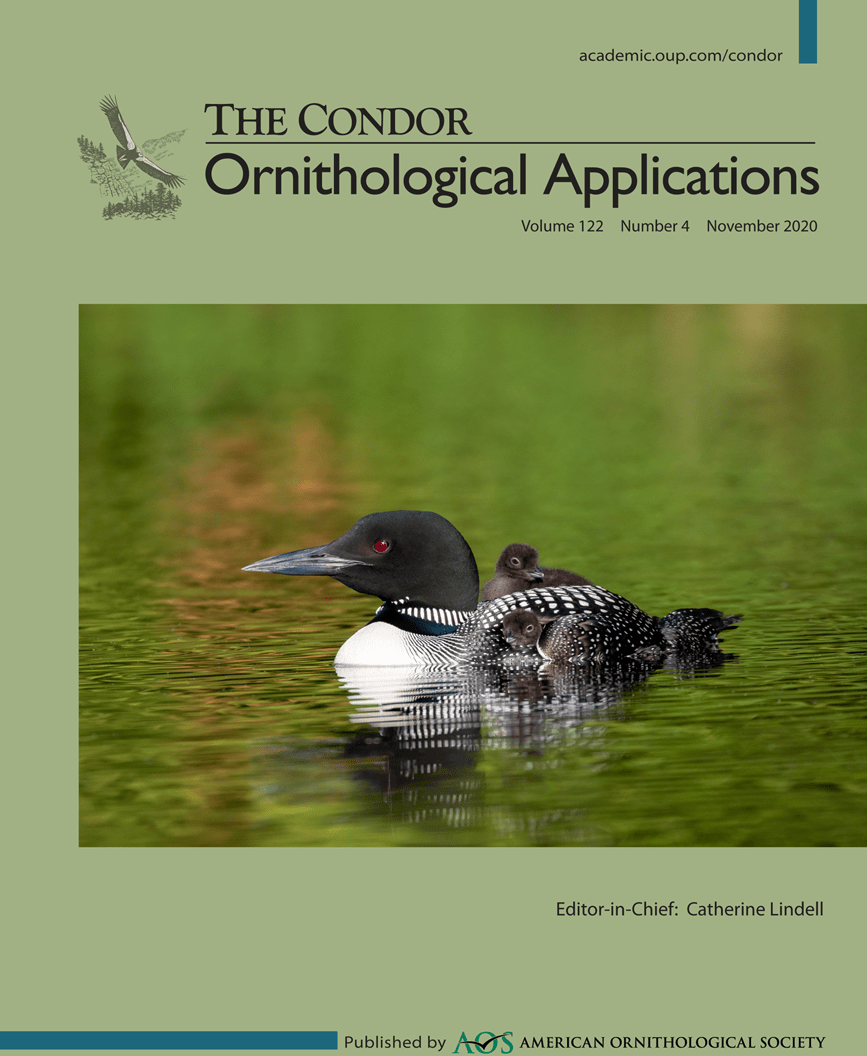
We have had a good week on the Loon Project. A few days ago, the November 2020 issue of Condor: Ornithological Applications came out that contains our article on the declining loon population in northern Wisconsin. Our article was selected as an “Editor’s Choice” for the issue! Linda’s photo graces the cover, and it

features Linda’s “own” loons in a touching embrace. Of course, there is brutal irony here. The article documents the fact that there are fewer and fewer two-chick broods in the Northwoods these days. Linda’s picture, therefore, displays an exception to the trend of reduced breeding success in the past quarter century.

Speaking of our article, as of today it is the one most frequently read by visitors to the journal’s website. I take heart to see this; maybe that means that we are getting the word out that Wisconsin’s loon population should not be taken for granted. During my optimistic moments, I hope that attention focused on the fragility of our population and its current downward trend might help us take the first easy and obvious step to help loons. What is this step? First, we must get rid of lead sinkers and jigs, which kill many Wisconsin loons each year painfully and needlessly. This requires simply having the sense of responsibility to replace all of the sinkers and jigs in our tackle boxes with lead replacements that work just as well but do not kill loons and other wildlife. If we take this simple step and — here’s the hard part — have the chutzpah to ask our friends and relatives and neighbors to do the same, we can start a wave and get it done. Are you willing to step up and do this for Wisconsin’s loons?

A second piece of good news for the Project this week was the acceptance for publication of our collaborative paper on climatic and land-use impacts hurting the northern Wisconsin loon population. As with the just-published Condor article, this accomplishment is decidedly bittersweet. While it is nice to have your work recognized as important and worthy of publication, it is a shame to see yet more scientific evidence that spells trouble for loons.

After I explained that breeding loons must learn about their neighbors’ chicks through yodeling of neighboring males, my mother-in-law shot back:

Wouldn’t that behavior be counterproductive for the yodelling male and hence, be modified in his progeny……….unless it’s paired with positive results. What would that be? What’s the point of the yodel once he has a mate?

There are a couple of points to address here. First, a small one. Joanne implies that male loons — like most songbirds — use the yodel to attract a mate. The concept that bird song is a signal to potential mates is so firmly entrenched in our brains that we almost take it for granted. We know that most males that yodel are already paired with a female (like the Manson Lake male in Linda’s awesome photo, above). So, at best, mate advertisement could only be one of multiple functions of the call. Alas, though, we have no data on this question. I know — the yodel as a signal to potential mates seems a simple idea — but no one has yet played yodels from a territory in April and early May and counted the ratio of males and females that hear the yodels and visit the territory. If yodels function as advertisement for a mate, of course, we would expect a high proportion of all visitors to a territory from which yodels are emanating to be unpaired females. Sounds like a good Masters’ project!

Now on to Joanne’s main point. She is absolutely correct that behavior, like other biological traits of animals, should not occur unless it increases fitness — that is, unless it increases the number of offspring produced by the individual showing the behavior — and, hence, the number of individuals that possess that trait in the next generation. So yodels by males should not have evolved if all they do is bring the neighbors in from next door to spotlight the chicks! However, as Joanne suggests, we might sometimes expect that a behavior could have two (or more) impacts on evolutionary fitness. In other words, behavior might affect fitness negatively in one way, yet provide a benefit in another way that more than offsets the negative impact.

Now let’s apply this concept of “multiple impacts” to the loon case. Based on published work, we know that yodels are useful to loons in that they: 1) prevent landings of intruders that might evict a territory owner, and 2) keep intruders that have entered a territory from approaching the chicks closely. Therefore, I surmise that these two fitness-enhancing consequences of yodels are so beneficial to yodelers that they more than offset the negative impact of increased spotlighting of chicks by neighbors. In the interest of full disclosure, I must admit that it is very difficult to measure the impact of behaviors on fitness precisely, so we must be content, at this point, to know that yodels are beneficial in some ways and costly in others.

In thinking about Joanne’s question some more, let me provide a bit of context for the idea of spotlighting. While it is an exciting advance for loon biology to learn that loons are probably spotlighting each other’s chicks, “eavesdropping” on each other’s yodels is not surprising to behavioral ecologists. Eavesdropping, defined as intercepting of signals directed at a specific receiver by a third party that is not the intended target of the signal, turns out to be widespread in animals and makes a lot of sense. If you are a young loon floater trying to obtain a territory — especially a male floater — you would benefit immensely from listening to the territorial defense signals of established males in your neighborhood, since yodels are known to convey information about the identity, body size, body condition, age, and motivation to attack of the yodeler. If you hear from his yodel that a certain male is large and likely to be aggressive to intruders, you would do well to avoid landing on his territory!

Eavesdropping is one of several phenomena that behavioral ecologists have discovered by taking a second look at animal behaviors that seemed not to square completely with known behavior patterns. Another such phenomenon is “prospecting” by young animals looking to settle in a region. Young adults of many species that are in search of breeding territories explore their habitat extensively in one year and then settle the next year in specific areas where they had detected cues indicating successful reproduction (such as the sight or sound of offspring) the year before. Loons prospect for territories too.

Prospecting?? Eavesdropping?? Wow…..loons sound more like us every day!

If you have been reading my posts, you are aware that we now have good evidence for spotlighting of chicks. That is, our data suggest that: 1) parents of chicks systematically visit neighbors that also have chicks; 2) the added presence of these visitors draws in more young adult “floaters” to those neighboring lakes; 3) some of the floaters induced to visit neighboring lakes spot the neighboring chicks; and 4) these added chick detections by floaters result in increased attempts to evict the neighboring pair during the following year. Thus, adult loons with chicks draw the attention of local floaters to neighboring lakes and chicks and away from their own lake and chicks, decreasing the risk of losing their own territory to eviction.

Like most newly discovered behavioral processes, spotlighting alters the landscape and forces us to inspect some aspects of loon behavioral ecology more closely. Here is one puzzle raised by spotlighting: how do loons with chicks find out about the chicks of neighbors? Put another way, how does a breeding pair that is in the midst of protecting, feeding, and hiding their own young have time to spy on the neighbors so that they know where to spotlight? Remember that floaters, unlike established breeders, have no territories or chicks to defend, so they can spend weeks and weeks doing nothing but obsessively intruding into lakes to spot chicks and thus planning future eviction attempts. Territorial breeders with chicks, in contrast, must defend their territory, incubate eggs, and forage for and guard chicks. At best, they only have an hour here or there when they might leave their chicks behind and search for the chicks of others.

The answer probably has to do with territorial yodels. Yodels — like the one I recorded above on Muskellunge Lake (Lincoln Co.) in 2008 — are quite rare, and they occur mostly in a few narrow contexts. Specifically, yodels are frequent in all territories during the first few weeks after territory resettlement in the spring, are quite infrequent throughout incubation, and then suddenly spike again right at the time of hatching. This very precise, predictable pattern of territorial yodels thus conveys reliable breeding information to all loons (and knowledgeable humans) within acoustic range. Imagine, for a moment, that you are a territorial loon with close territorial neighbors both north and south of you. You hear: 1) an early burst of yodels from the north in late April and early May, 2) few or no yodels from the north for a four-week period, 3) a sudden burst of yodels from the north over a two-week period, and 4) occasional yodels for a few more weeks after that. This yodel pattern almost certainly indicates that a loon pair settled on the territory north of you, incubated their eggs for four weeks, hatched chicks, and reared them successfully for at least several weeks. Hence, this yodel profile from the north territory gives you vital information about the presence or absence of chicks without you ever having to leave the safety of your own territory. In fact, you might even be able to infer whether the north pair has two chicks or only one, because males defending two chicks yodel about three times as often as males defending a singleton chick! The fate of the breeding efforts of the pair to the south of you will also be evident acoustically. If you hear the same pattern of yodels to the south as you heard from the north, you know that the south pair too has a chick or chicks. And if the south pair yodels often only in April and May but seldom during the remainder of the summer, then they have failed to hatch chicks. When we look at the system closely, therefore, we realize that the fact that a breeding pair can collect a wealth of information about the neighbors without ever leaving their territory makes it much easier for them to detect the chicks of neighbors than it is for floaters (which intrude only occasionally) to do so.

In summary, the greatest puzzle regarding spotlighting — “How do breeding pairs know where to do it?” — is easily solved. Furthermore, scientists salivate at a behavioral system of this kind. Why? Because we can do a simple experiment to confirm it. Specifically, we can record yodels from Lake A, which is adjacent to Lake B, play Lake A yodels back to the pair with chicks on Lake B so as to simulate chick production on Lake A, and see if the Lake B pair intrudes into Lake A to spotlight the chicks there. If, as we surmise, pairs with chicks are spotlighting neighbors’ chicks, we should be able to induce a pair with chicks to intrude into a neighboring lake without chicks by playing yodels to them in a seasonal pattern that simulates settlement, incubation, and hatching of chicks by the pair next door!