
Humans are social animals. Living as we do in an environment full of family ties, friendships, and competitive rivalries, we must be skilled at recognizing other members of our species as individuals and assessing the benefit or threat they pose to us. An abundance of individual cues help us identify each other, including face, body shape, posture, size, gait, voice, and mannerisms. When you consider the vast array of human attributes that betray identity, it is not surprising that we can recognize conspecifics easily — and often from a great distance.
But loons are far less social. Although loons gather in large groups seasonally, these are either: 1) loose aggregations of strangers waiting for ice out on their lakes in spring, or 2) feeding assemblages — again consisting of strangers — during the fall. During other seasons, loons are either solitary (winter) or confined to a territory with their mate and chicks (summer). Based on their limited sociality, then, we would predict that loons should recognize conspecifics rather poorly. That is, loons must be able to tell their mate apart from intruders. And breeders should also recognize neighbors, which do not threaten their territorial ownership, and the few young nonbreeders that intrude persistently into their territory and do threaten it. But loons have no friends and allies, as most humans do. So we would not expect loons to be able to recognize scores of individuals of their species.
Field observations support the idea that loons have limited ability to recognize conspecifics. When one pair member returns to its mate after a trip off territory, we can observe mate recognition in action. Loons are typically uneasy in the initial stages of such reunions. In many cases, the returning pair member lands 50 meters or more away from its mate. Both pair members immediately assume an alert posture. After several anxious minutes, the returning pair member creeps closer to its mate, and eventually both pair members relax and begin to act normally. Observations of this kind suggest that: 1) even loons’ recognition of their mates is not immediate, and 2) recognition is difficult at a distance but apparently easier at close quarters. In short, loons’ ability to recognize individuals falls far short of humans’, as we expected.
Why should we care whether loons can be told apart? There are two reasons. First, proving that loons can distinguish each other visually — and under what circumstances they can do so — would help us understand their social behavior. Although casual observations suggest that inter-individual identification is difficult, we have no scientific data on the topic. Second, if we could tell loons apart from their plumage, we could use photos alone to determine whether both, only one, or neither member of each territorial pair from the previous year had returned. In this case, a reliable record of annual photos of many breeding pairs from a specific population might permit accurate monitoring of that population without capture and marking.
We have reason for optimism regarding photographic identification of individual loons. Humans can learn to distinguish individual swans from bill markings and geese from neck patterns. While loons may not differ one from another as obviously as some swans or geese do, breeding adults seem to differ consistently in bill size and shape, the pattern of branching white lines on the neck collar (see below), and perhaps also the density of white spots on the back. So it seems conceivable that photos alone might be used to tell one loon from another.
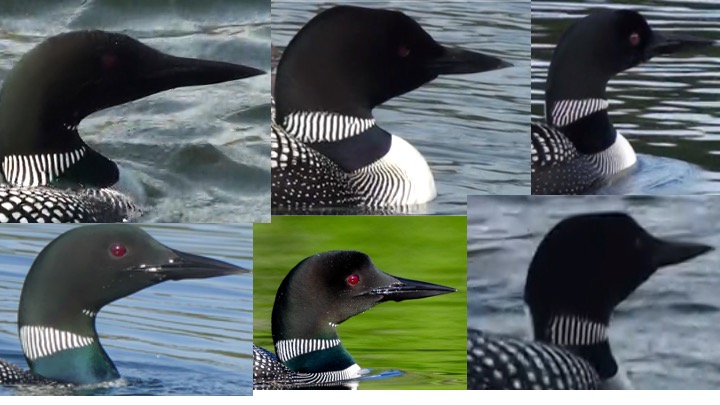
Fortunately we do not have to rely upon fallible humans for recognition of loons. The development of image recognition technology — used for human facial recognition — allows us to delegate the hard work of distinguishing between loons to computers. In fact, a Chapman colleague in the Information Systems and Technology department has been using artificial intelligence technology to help a computer learn what individual loons look like for the past several weeks. Her initial findings, which are highlighted in the featured image above (based on photos by Linda Grenzer and myself) are promising.
Will we be able to cease banding loons altogether in coming years and rely instead upon photographers and computers to do our work? No. As our recent finding of loss of body mass by loons has shown, we will always need to capture and measure loons in order to track fully the health and sustainability of populations. But use of AI might allow us to increase the number of populations from which we can glean information about adult survival, a crucial demographic indicator. That would be a huge advance.
By the way, many folks chipped in generously to our field effort. Thanks so much to all who donated! We now have sufficient funds to support full teams of four students in Minnesota and Wisconsin both for the first time ever. So 2024 should be a banner year for data collection. Let the loon photography begin!